

With so many different lenses on the market today, it's no wonder that many people are asking "What are Bifocals?"
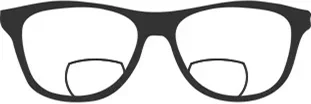
Bifocals help those that require vision correction for myopia (short-sightedness) and presbyopia (long-sightedness). The lenses allow clear vision at either distance within one pair of spectacles.
They can be thought of as ordinary prescription lenses with an additional reading segment. The reading segment is usually positioned towards the lower part of the lens.

Brief History Of Bifocal Lenses
It is thought that Benjamin Franklin invented Bifocal lenses in the late 1760s. However, evidence now suggests that others may have worn "Split Bifocals" before him. As he aged, Franklin required separate glasses for distance and near use.
Growing tired of constantly changing his spectacles, he decided to do something about it. His solution was to cut the lenses from each pair in half. He then split the lens into two halves. Distance lenses at the top. Reading at the bottom. Franklin could now use one pair of glasses for clear vision at both distances. He originally named them "Double Spectacles".
Modern technology has certainly helped to improve Bifocals. They are now more durable and stylish, as well as more widely available. But despite these technological advances, they still work largely in the same way.
Types of Bifocal Lenses
D Seg Bifocals
The reading area of the D Seg Bifocal looks like a letter D positioned on its side. They may be referred to as a Flat Top Bifocal. The D Seg is the easiest Bifocal design for a wearer to adapt to. Because of this, it's the most popular type on the market today.
Key Features
- Easiest to adapt to
- Most popular type available
- Available in D 28 and D 35 sizes
Additional Benefits
- Wide reading area
- Smooth transition between segments
- Excellent for daily wear

Round Bifocals
As the name suggests, the round bifocal is round at the top. They were originally designed to help wearers reach the reading area more easily. However, this reduces the width of near vision available at the top of the segment. Because of this, round bifocals are less popular than the D Seg.
Key Features
- Round top design
- Easier to reach reading area
- Available in R 28 and R 25 sizes
Considerations
- Reduced near vision width
- Less popular than D Seg
- Still effective for many users

Curve Top Bifocals
The Curve Top Bifocal, or the C Bifocal, is almost identical to the D Seg. A slight curve at the top of the lens is the only difference. Once more, the near vision segments are available in different widths. The C 28 is the most popular size available.
Key Features
- Similar to D Seg design
- Slight curve at the top
- C 28 is most popular size
Benefits
- Easy adaptation
- Wide reading area
- Available in different widths
Ready to Find Your Perfect Bifocals?
Need a new pair of Bifocals? Discover a huge range of fashionable glasses available at Spex4Less including 100% satisfaction guarantee and 12 months warranty.